


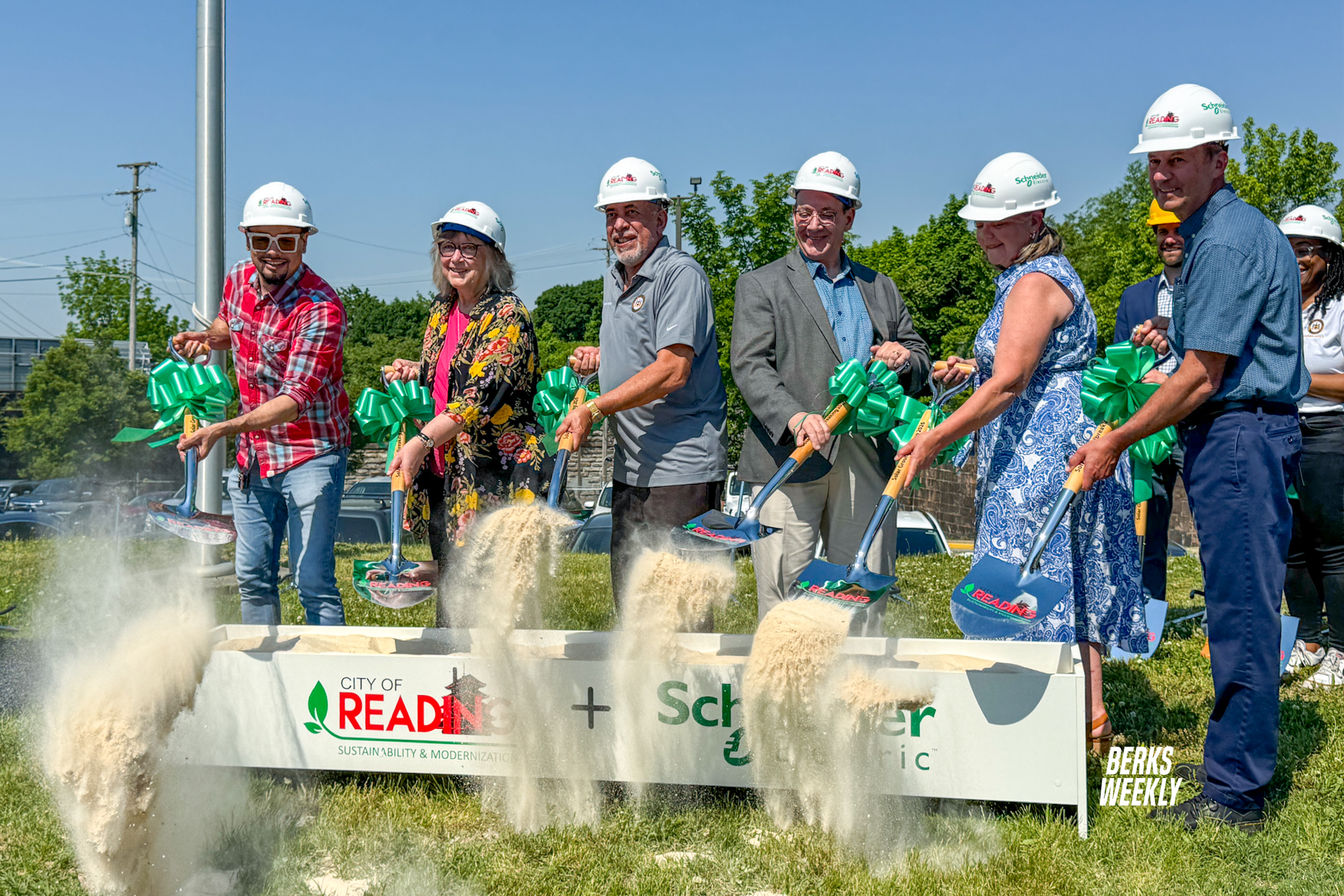
The City of Reading officially broke ground Monday on a major solar energy project at the Public Works campus, marking another step toward the city’s goal of transitioning to 100% renewable energy by 2050. 
City officials, members of City Council, sustainability leaders, and representatives from Schneider Electric gathered at the Public Works Building on North Sixth Street to celebrate the start of construction on the project, which will include 4,255 solar panels installed across city facilities.
According to the City, the project includes 3,180 solar panels at the Public Works campus and 1,075 panels at the Cedar Street parking lot near City Hall. Once completed, officials said the solar canopies are expected to fully offset electricity usage at City Hall and the Public Works Administration and Garage.
Mayor Eddie Morán said the project reflects the city’s continued investment in modernizing municipal infrastructure, improving energy efficiency, and reducing long-term operational costs.
“Today’s groundbreaking represents another important step forward for the City of Reading,” Morán said in a statement released after the event. “These projects are helping us lower costs, stabilize our energy budget, reduce air pollution, and make city facilities more sustainable and efficient for years to come.”
During the ceremony, Morán said the groundbreaking represented the continued work of the administration to modernize city facilities and make “smart investments that will benefit our community for years to come.” 
The project is being completed in partnership with Schneider Electric and builds on several energy-related improvements the city has undertaken in recent years through the Guaranteed Energy Savings Act program. According to Morán, those upgrades included the installation of more than 3,200 LED lights across city buildings, parks, recreation centers, and public spaces, along with upgraded sports lighting systems at multiple parks and new HVAC improvements at several facilities. 
Morán said the city has already seen approximately a 15% reduction in energy costs at participating sites compared to its 2024 baseline. 
Reading City Council President Donna Reed described the project as an investment in the city’s future and noted the historical significance of the Public Works property, formerly the site of Reading’s Outer Station rail hub.
“This is our investment. This is our hope for the future. This is our realization for the future,” Reed said during the ceremony. 
Sustainability Manager Bethany Ayers Fisher said the solar canopies will generate electricity for city operations while also providing shade and protection for municipal vehicles. 
Ayers Fisher explained that the system will operate through net metering, allowing excess electricity generated by the solar installations to be returned to the power grid in exchange for credits on the city’s energy bills. Those credits can then be used to offset costs at other city facilities, including traffic and street lighting systems. 
According to the City, the project is projected to reduce annual electricity costs at City Hall and Public Works from approximately $268,550.76 in 2025 to zero dollars by 2027. Over a 20-year period, officials estimate the larger GESA initiative will generate approximately $13.5 million in return on investment, with savings expected to grow if energy prices continue to rise.
Ayers Fisher said the project will also help reduce heat island effects in parking lots, provide protection for city vehicles during severe weather, and reduce the city’s exposure to volatile energy markets. 
“Investing in local renewable energy infrastructure makes good fiscal sense,” Ayers Fisher said in the city’s release. “These projects will help stabilize our operational budget, reduce pollution, and allow us to continue investing in our community.”
During her remarks Monday, Ayers Fisher also credited the city’s Environmental Advisory Council, Pennsylvania Department of Environmental Protection, Penn State University, FirstEnergy/Met-Ed, city staff, and project contractors for helping guide the project from planning into construction. She also recognized the “Reading for 100” initiative, which advocated for the city’s renewable energy goals beginning in 2018. 
Construction on the solar canopies is now underway.
