


This story was produced by the Berks County bureau of Spotlight PA, an independent, nonpartisan newsroom. Sign up for Good Day, Berks, a daily dose of essential local stories at spotlightpa.org/newsletters/gooddayberks.
LOWER ALSACE — Antietam School District officials say a lack of funding and viable alternatives are forcing them to construct an elementary school at the same site where another building was destroyed in a devastating flood.
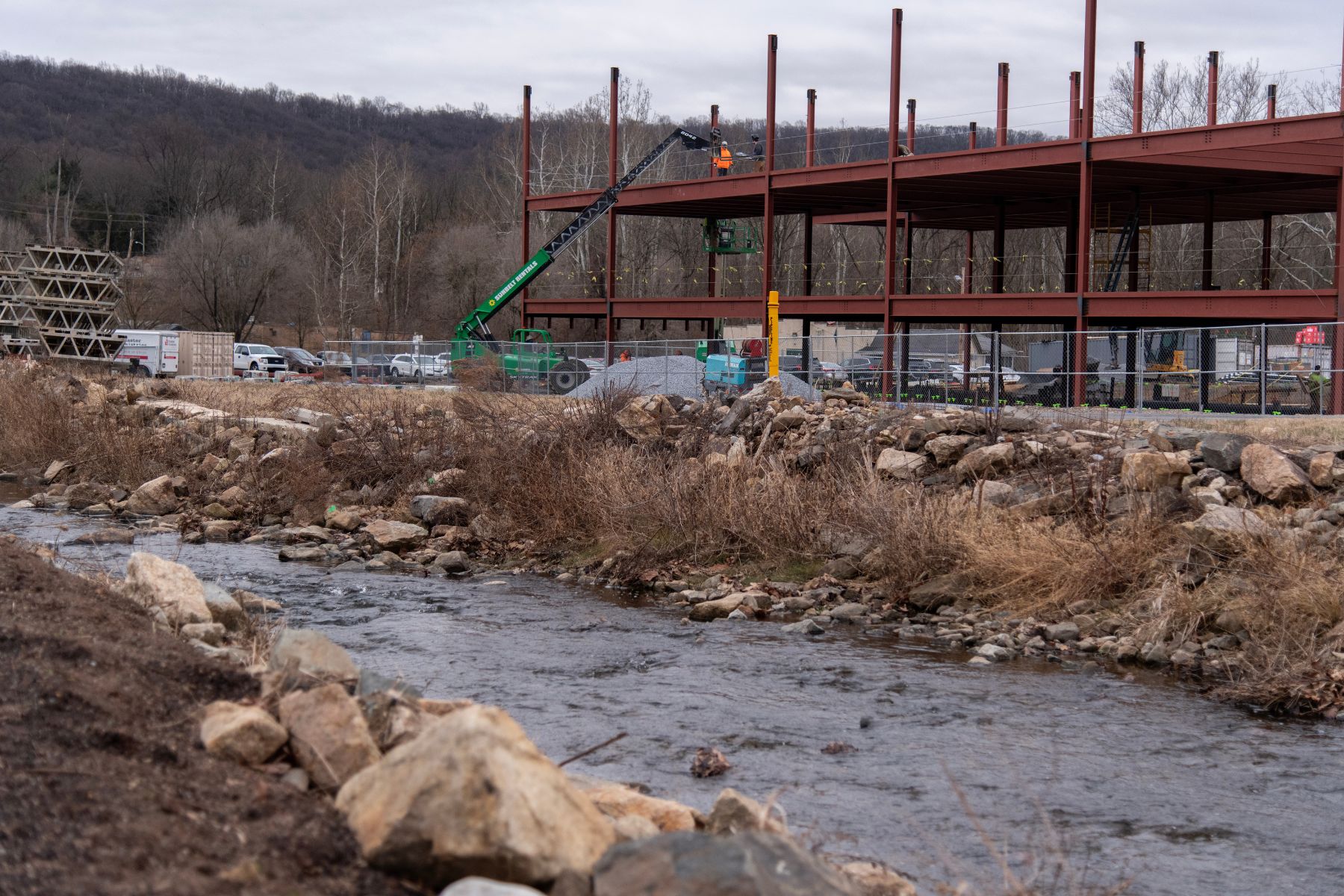
The property is in a 500-year flood zone, a location where critical facilities are not supposed to be built, according to disaster planning best practices. Since the district can’t relocate the building, experts say it should practice preventive measures like analyzing for future flood risk and building above base flood levels.
District officials say the plan raises the building and adds additional stormwater management features, but declined to answer repeated questions about whether a flood risk analysis was done. Such analyses can provide data that prevents developments from increasing flood risk for others.
The site is located along Antietam Creek and has dealt with flooding for years. Creekbed repairs were underway in July 2023 when water, rubble, and other debris came down a mountain, dammed the creek, and inundated the former middle-senior high school. Only the district’s administrative offices were spared.
The flood destroyed the school’s mechanical systems and equipment. Mold and mildew festered, and engineers feared that moisture trapped in the fill dirt around the school’s foundation would cause further structural damage.
Officials said it didn’t make sense to salvage the middle-senior high school, whose students were permanently relocated to other district buildings. But abandoning the site also wasn’t an option for the highest-taxed district in Berks County.
Ultimately, the district decided to set up modular classrooms for their youngest students on the athletic fields at the flooded site, demolish the old building, and construct a new Stony Creek Elementary School there. Expected to cost $30.3 million, the building will be elevated and oriented so that water will flow past it, Superintendent Tim Matlack said.
Administrators considered building the new school at a nearby sports field, but found doing so would cost more than the current project “because it lacks any existing infrastructure,” according to Matlack.
Purchasing an existing building at 705 Friedensburg Road and rehabbing it offered less space, he said.
Antietam officials didn’t provide complete estimates for those alternatives, so it’s unclear how much higher the projected costs were. What is known is that the district is already in a precarious financial situation, as it had to raise taxes partially to cover the $10 million bond necessary to fund construction.
Flood risk and best practices
The school site is located at 100 Antietam Road. Downstream, the Stony Creek Athletic Association’s clubhouse is located at 165 Antietam Road. Despite being only a few hundred feet apart, the sites are considered to have different flood risk levels by the federal government.
The athletic association is in the 100-year floodplain, which is a regulated floodway with a 1% annual chance of flooding, as designated by the Federal Emergency Management Agency (FEMA). Property owners in these zones, which are considered to be at high risk for flooding, may be required by mortgage holders to purchase flood insurance. Association President Stacy Karras said it has never been able to secure coverage.
Meanwhile, the school site is in a 500-year floodplain, which has a moderate risk of flooding, between 0.2% and 1% annually. These properties aren’t required to have additional flood insurance, yet nearly 30% of insurance claims are from policyholders in moderate- or low-risk areas.
The district had a $3 million insurance policy when the school flooded, which included a $500,000 maximum FEMA allowance for commercial property and $2.5 million from a private insurer, according to Antietam school board members.
According to a 2017 Pew Charitable Trusts analysis of public schools nationwide, 4,106 schools in the United States are located in the 500-year flood zone. There are 2,247 schools nationwide in the 100-year floodplain.
But water doesn’t adhere to lines on a map, experts warned, and floodplains can change over time.
“I think one of the important things to keep in mind is that floodplains are not static. They’re constantly changing, and they change for a variety of reasons, including changes in the topography of the area, changes in the environmental conditions,” said Mathew Sanders, senior officer with the Pew Charitable Trusts’ U.S. conservation project, which helps prepare states for disasters.
Researchers anticipate high-risk flood areas in “riverine and coastal communities will expand by 45% and 55%, respectively, by the end of the century,” the 2017 Pew analysis said.
Those variables and risks are why best practices call for placing critical facilities and infrastructure outside of both 100-year and 500-year flood zones, Sanders said.
In Chester County, the Water Resources Authority recommends floodproofing and other flood mitigation efforts within 500-year flood zones, said Seung Ah Byun, its executive director.
“From the numbers I’ve seen, [those zones are] already becoming the 100-year” floodplain, she said. “So, at some point, when those floodplains are being mapped, they’re going to widen, more than likely, because the storms are bigger and more intense.”
Berks County, however, does not provide direct guidance to its localities on flood mitigation. Every five years, the county Department of Emergency Services updates a hazard vulnerability assessment and mitigation plan with input from municipalities, but mitigation projects are spearheaded by those communities. The projects are often prompted by individual owners who manage waterways on their property.
When a building can’t be relocated, Sanders said it’s crucial to have a strong understanding of the risk for future flooding. He said using datasets and future flood risk modeling tools can scientifically determine the risks and help produce designs that ensure buildings withstand those conditions.
Before approving the school’s development plans last year, Lower Alsace Township — where the school is being built — recommended Antietam remodel the floodplain to “determine the current flood elevations” based on the latest conditions.
The school’s engineers reassured officials that the driveway grading between Antietam Road and Vesper Avenue would create additional flood storage in the area and improve site conditions. They also pointed to the building’s higher elevation and other mechanisms for ensuring its future ability to withstand floods.
Administrators did not provide records of any flood risk analyses when asked by Spotlight PA and would not confirm whether one was completed.
Antietam’s engineer on the project said all agency requirements for construction were met “as part of the final approval process.”
Lower Alsace has a floodplain zoning overlay that limits development in 100-year floodplains, as well as development that would exacerbate flooding in those areas, but it does not have floodproofing specifications.
Jim Cinelli, of Liberty Environmental, a Reading-based environmental consulting and engineering firm, said the way to address flood risk in Antietam’s situation is “simple.” “It’s constructing buildings with a first-floor elevation that’s higher than the base flood elevation,” he said.
The new school does that, and Matlack said the plans incorporate lessons from the 2023 flood. The school’s basement will be used for storage only, and critical infrastructure will be housed two feet above the floodplain.
And the school will work with legislators and community leaders to get funding to mitigate the creek. “Not just near the school, but the entire length for the sake of the local communities as well as the school district,” he said.
Funding
Even before its middle-senior high school was destroyed in 2023, the Antietam School District was financially squeezed.
Schools are primarily funded by local property taxes — a revenue source dependent on the wealth and expanse of the community being levied — which creates disparities throughout the state.
Antietam’s tax rate of 51.3 mils is higher than the regional and statewide median of Pennsylvania’s 500 public schools. But there are still over 150 districts that have higher rates than Antietam.
Those disparities led Commonwealth Court to declare the state’s school funding system unconstitutional in 2023 and task lawmakers with creating a formula to close the gap. The annual funding gap for Antietam is nearly $5 million, and only about $538,000 has been provided so far.
That funding, however, doesn’t include costs for maintaining and upgrading school facilities, which can be steep. And like other school districts in Pennsylvania, Antietam has limited resources to tap.
The district educates fewer than 1,200 students, a population that is less than Reading School District’s Central Middle School. Additionally, nearly 20% of Antietam students live below the poverty line, and over 30% of families receive food aid.
Compounding the district’s challenges are the existing aging assets. A floor in the Mount Penn Primary Center — where grades 9-12 students are educated — collapsed in 2024 ahead of the fall semester, complicating school year plans and delaying the start.
Matlack said Kerry C. Hoffman Intermediate School on Cumberland Avenue in Mount Penn is now the district’s neediest building.
Systems there need to be improved or replaced, and classrooms and fixtures are upward of 40 years old. For now, the district is replacing smaller items, like old boilers, to take “more manageable steps at a smaller cost over time,” he said.
“We’ve prioritized investing in anything safety-related but scrutinized most other costs to determine if they can be put on hold,” Matlack said.
Merger talks with other schools over the years have gone nowhere. Resurrected in the immediate aftermath of the flood, the conversation also fractured the Antietam community, with some residents pushing back on the district’s emergency schooling plans.
This leaves most of the financial responsibility on Antietam taxpayers. The district received $11.2 million in state grants for the Stony Creek project, reducing how much is borrowed, but Matlack said they’ve been pushed to the limit, given the necessary renovations to turn the primary center in Mount Penn into a high school.
Antietam raised property taxes to help pay for the $10 million bond the district took out at the beginning of 2025. Administrators also had to factor in nearly $2 million for demolishing the flooded school and unanticipated mold remediation costs for the modular classrooms.
To avoid untenable tax hikes, Matlack said the district has deferred maintenance and left open positions unfilled.
“Rather than trying to make immediate maintenance impacts, we are trying to plan a longer-range approach,” he said. “Our hope is that in doing so, nothing major fails and puts us in a bind of needing to make a single large purchase like we’ve continuously been forced to do with the flood recovery.”
BEFORE YOU GO… If you learned something from this article, pay it forward and contribute to Spotlight PA at spotlightpa.org/donate. Spotlight PA is funded by foundations and readers like you who are committed to accountability journalism that gets results.
