


At Penn State Berks, students are conducting research that makes an impact, from emotional regulation in children to microbial life in the Blue Marsh Watershed. Students have presented their work at local and national conferences and co-authored scholarly articles with faculty, while building their confidence – and their resumes.
Research is part of Penn State’s three-part land-grant mission (teaching, research and service), and at Penn State Berks, many students take advantage of the opportunity to conduct research, working one-on-one with faculty members. This past year, more than 100 Penn State Berks students conducted undergraduate research, mentored by more than one quarter of the college’s faculty. This does not include the many research opportunities provided to students in many forms in their classes.
Berks Undergraduate Research and Creativity Symposium (BURCS)
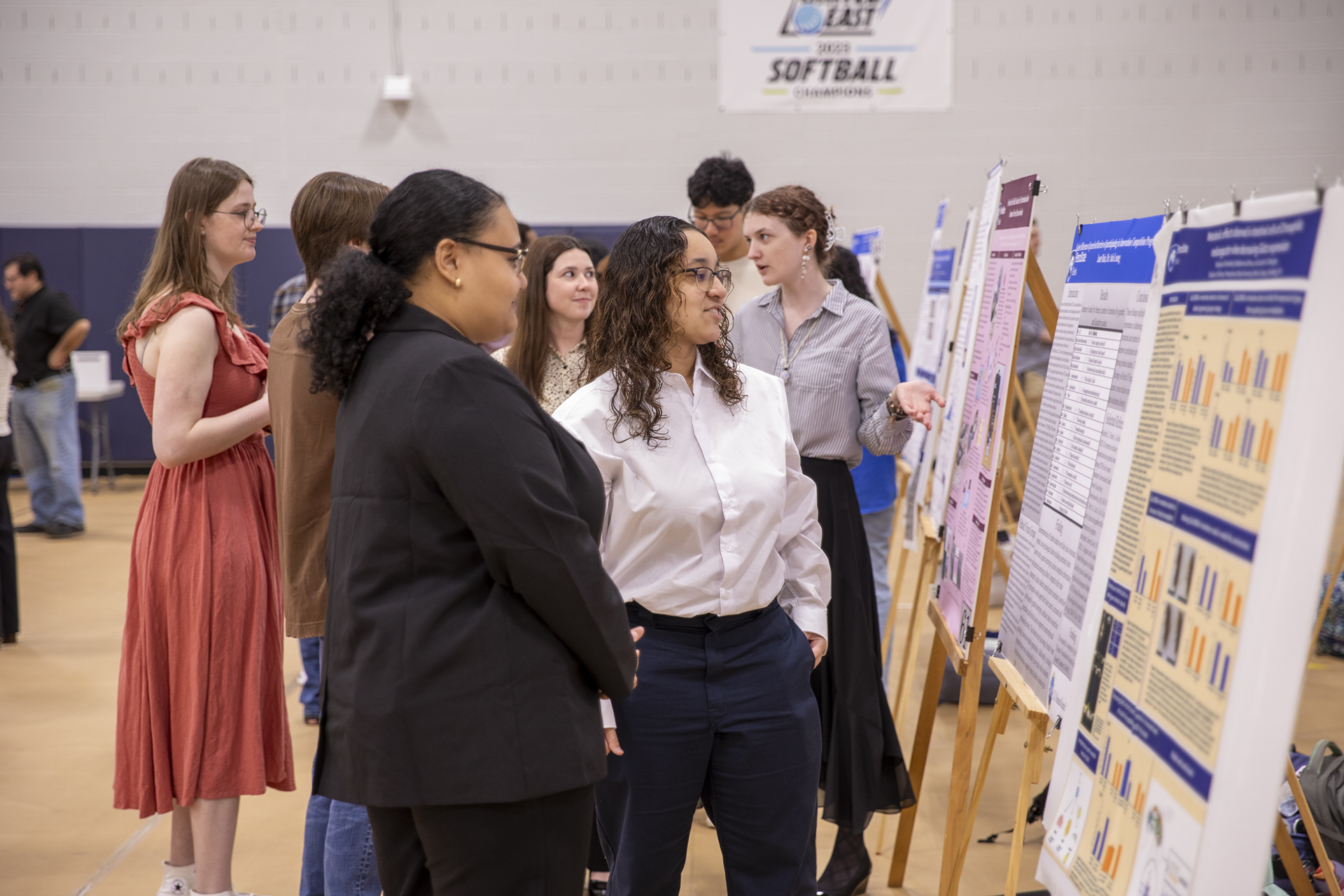
In 2025, Penn State Berks established the annual Berks Undergraduate Research and Creativity Symposium (BURCS) to give students an opportunity to present their research to the Penn State Berks community. In 2026, students presented 90 posters and table displays, delivered five oral presentations, and showcased 15 honors presentations. The event was attended by more than 200 faculty, staff and students.
BURCS awards were presented to one student or student group from each academic division: Engineering, Business and Computing (EBC); Humanities, Arts and Social Sciences (HASS); and Science.
- Talan Nguyen, mechanical engineering major from Pottstown, Pa. (EBC)
Thermorph: Engineering self-transforming structures through programmable material actuation
This project studies how Thermoplastic Polyurethane (TPU), polymers that become pliable when heated and harden when cooled, can be used in 3D printing to generate structures that fold. Nguyen found that the longer the TPU filament was, the more folding that could occur with the 3D printed structures. - Cristian Corona-Olivares, business major from Reading, Pa.; Diana Ruiz Guzman, education and public policy major, Breinigsville, Pa.; Spencer Weyant, kinesiology major, Shoemakersville, Pa.; and Ashira Kolupoti, undergraduate studies pre-major, Belle Mead, N.J. (HASS)
Restoring civic engagement in the age of expanding news deserts
Using the Pittsburgh Post-Gazette as a case study, this project examines how the loss of local news outlets contributes to the rise of news deserts and weakened community oversight. Previous research shows that reduced access to local journalism is linked to lower civic participation, increased exposure to misinformation, and greater risk of political corruption. - Kyla Ebersole, biology major from Richland, Pa. (Science) Using soundscapes for research and monitoring of common tern foraging trends. In this study, Ebersole designed a method to measure the sounds associated with feeding (foraging calls) in the Common Tern, a colonial waterbird. This method can be used to study how weather conditions affect feeding for these birds.
The BURCS was organized by Justin DiAngelo, professor and program chair of the biochemistry and molecular biology degree program, and Allison Altman Singles, associate professor of kinesiology and mechanical engineering. Both DiAngelo and Singles have extensive experience working with students on research.
Singles commented, “We were excited by the many wonderful discussions happening around the event about our students’ research and creative projects. This year we had a 30 percent increase in the number of students presenting at the symposium and we hope the momentum and excitement continues into future years.”
Funding to support BURCS was provided by Dr. Frank Franco Undergraduate Research Endowment.
Higher Education Council of Berks County Research and Creativity Symposium
This year was the 25th anniversary of the Higher Education Council of Berks County (HECBC) Research and Creativity Symposium. The annual event is coordinated by the HECBC, which is comprised of the six Berks County colleges: Albright College, Alvernia University, Kutztown University, Penn State Berks, Reading Area Community College and the Drexel University College of Medicine at Tower Health. The conference provides undergraduate students with the opportunity to showcase research and creative accomplishments while engaging with peers, faculty and the community. This year, 40 Penn State Berks students presented at the conference.
Summer Undergraduate Research Fellowships
To provide support for students who conduct research over the summer, Penn State Berks established the Summer Undergraduate Research Fellowships, which provides students with $5,000 to support their research projects. In the summer of 2026, research fellowships were awarded to the following students:
- Alexandra Alers, psychology major from East Stroudsburg, Pa.
Exploring the relationship between sensory processing and emotional regulation in early childhood
This study investigates whether increased tablet and screen use in early childhood influence sensory processing and self-regulation skills. By exploring these developmental pathways, researchers hope to gain a better understanding of the factors that contribute to long-term mental health and overall well-being. - Mary Namy, biochemistry and molecular biology major from Northampton, Pa. Experimental evaluation of phytoplankton community structure as a predictor or cyanotoxin risk under nutrient enrichment. Harmful algal blooms (HABs), caused by toxin-producing cyanobacteria, are becoming more prevalent in freshwater environments. The goal of this research is to determine how the environment in which cyanobacteria live can help predict the toxin levels produced by these bacteria.
- Ashmeen Sindhar, biology major from Ephrata, Pa. Longterm changes in antibiotic resistant microbial populations in the Blue Marsh Watershed: An exploration of resistance gene frequencies. This research studies the presence of antibiotic resistance genes within bacteria found in the Blue Marsh Watershed. As antibiotic resistance emerges as a pressing public health concern, it is important to understand evolving patterns and prioritize the health of bacteria in freshwater systems.
All three Summer Undergraduate Research Fellows are conducting research with real-world impact.
Alexandra Alers commented that conducting research will benefit her in the future. “It’s been really rewarding to continue exploring topics I care about while gaining more hands-on experience, and I’m excited to see how this research experience will benefit me and become a part of my future in graduate school and beyond.”
Likewise, Mary Namy explained that the experience that will help her reach her goals. “Since my first year, research has allowed me to grow both academically and professionally. Working on water quality research has shown me how closely science and public health are connected, and presenting my work has greatly improved my confidence. These experiences have shaped my journey toward medical school and my future career as a physician.”
Ashmeen Sidhar summarized the students’ experience, stating “Research at Penn State Berks has been very rewarding because it has allowed me to work with and learn from knowledgeable faculty mentors while exploring issues that matter to me. Through my research on antibiotic resistance, I am able to create meaningful work that advocates for environmental and public health.”
Funding for the Summer Fellowships was provided by the Penn State Berks Office of Academic Affairs.
Universities Libraries Undergraduate Research Awards
Penn State University Libraries presented its ninth annual Undergraduate Research Awards at the end of the spring 2026 semester to students at 19 Penn State campuses. Penn State Berks students who received this award include:
- Deanna Cao, biology major from Glendale, N.Y.
Computational amino acid tutorial for learning: Integrated with online network (CATLion)
The main goal of this research project was to evaluate the effectiveness of a computational amino acid tutorial as a learning tool in introductory chemistry education. The results indicate that this tool supports conceptual understanding while highlighting areas for improvement in navigation and accessibility. - Ashley Musante, psychology major from Lancaster, Pa. Why we miss GPS errors: The role of self-efficacy and cognitive bias. This study investigates why people rely heavily and trust GPS navigation, even when errors pose safety risks. The results showed that participants trusted GPS more in unfamiliar environments and favored their own device, even when users acknowledged greater potential for errors.
- Talan Nguyen, mechanical engineering major from Pottstown, Pa. Thermorph: Engineering Self-Transforming Structures Through Programmable Material Actuation
Talan Nguyen explained how he got started conducting research at Penn State Berks. “I started research during my first semester by reaching out to faculty members and following my desire to learn more than what my classes taught me. Being involved in research allows me to explore my interests in engineering while contributing to the field in a positive way. Research has given me a strong sense of purpose in college, and I look forward to continuing to explore the many opportunities it offers in the years to come.”
For more information about research at Penn State Berks, contact Todd Migliaccio, vice chancellor and chief academic officer, at TMM6950@psu.edu.
