



Trinity Lutheran Church, located at 527 Washington St. in downtown Reading, is preparing to celebrate its 50 years of Media Ministry on Sunday, Jan. 11. The public is invited to attend a fellowship breakfast at 9 a.m. and a Festival Worship for the Baptism of Our Lord at 10 a.m.
The church, whose elegant white Georgian steeple is among the first landmarks visitors see as part of Reading’s skyline, has weathered many storms over its 275-year existence as a congregation. While many of the storms have been political and cultural, some were literal—including a tornado that blew down the steeple in 1933, and an earthquake that cracked a wall of the sanctuary.
Twenty-five years before the Declaration of Independence was signed, Trinity celebrated its first baptism. From log cabin to a substantial brick edifice in Reading’s downtown area, the church has been there as Pennsylvania suddenly changed from an English colony to an American state, and then evolved through wars and technological changes and economic upheavals. Every aspect of American life has changed, but this congregation still exists.

And part of that survival, according to the current pastor, Rev. Hans E. Becklin, can be credited to the church’s ability to adapt—particularly in the technology they use to reach out to their own congregation and potential members.
“Trinity has been able to retain its size and strength while other downtown churches have closed, and our media program is a part of that,” Becklin said. “Being able to survive and thrive against difficult headwinds shows institutional strength. Our congregation is the same size as it was in the 1950s and 1960s, which was Reading’s supposed ‘Golden Age.’”
The Trinity media story actually begins in the 1920s, when the church started airing its services on local radio. But in 1973, during the ministry of the late Rev. Elton P. Richards, the idea of broadcasting the services on local television emerged out of a Vestry meeting. A committee was formed: chairman Darryl S. Jeffries and the late George Dougherty, James Davis, George Dengler and Bill Kerchner.
According to Jeffries, the committee obtained right-of-way from other properties in the downtown, including the Abraham Lincoln Hotel, so the proper infrastructure could be established to connect to BCTV (then owned by Berks Cable Company). In 1974 they also purchased cameras and other equipment for recording the services, and Jeffries was hired to be Trinity’s Director of Television, a part-time position. The first service was taped on June 1, 1975.
And then, the project hit a snag. From the perspective of the 21st century, as many of us spend so much of our lives onscreen in front of vast audiences, it is fascinating that some of the Trinity congregation began to object to having services broadcast live. “People were saying they came to worship, not to be on a TV program,” Jeffries said. “They saw it as an invasion of privacy.”
Broadcasting was put on hold, and Jeffries left the church soon after that (he has since returned). Gradually the idea was accepted, and Trinity began its media ministry on black-and-white TV, airing its Sunday morning services every Sunday evening at 7 through Berks Cable (now Comcast).
By 1982, thanks to a grant of $50,000 from the Lutheran Church in America, matched by another $50,000 from the C. Scott Althouse Endowment Fund, the Trinity was able to purchase a state-of-the-art color recording system, and establish a media center in the church annex. Brian K. Trupp was hired as Director of Media Ministry, and he recruited and trained members of the congregation to help in producing the televised services, working in groups of 10 on a rotating basis. The equipment was also used for producing training videos for staff and acolytes, and to record other programs, including Trinity’s Wednesday noon recitals, launched during the 1970s by the late Donald Hinkle, who served as organist and choir director from 1969 to 1996.
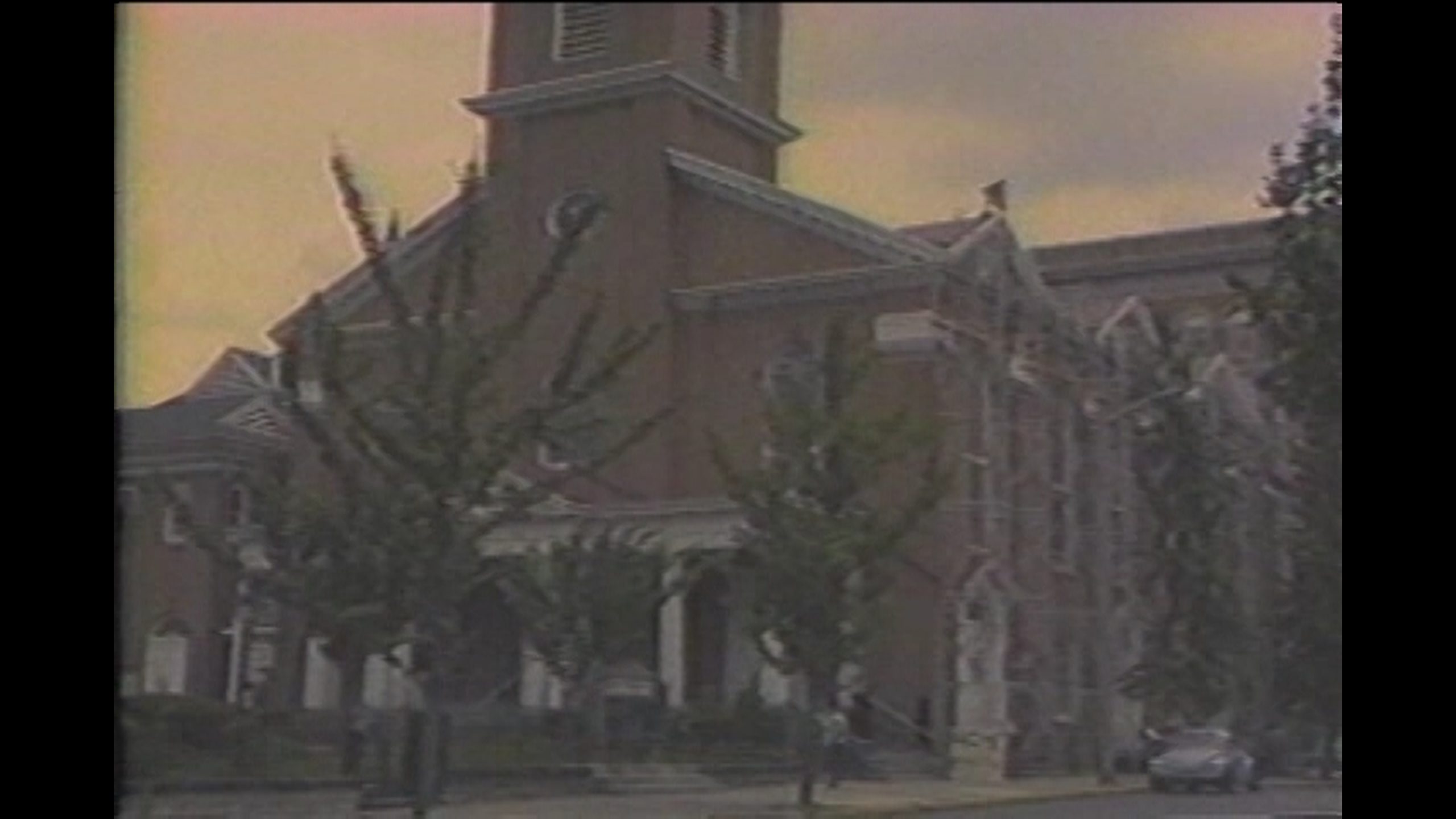
The outreach through television, rare at the time, remained a distinction for Trinity over decades, attracting viewers from all over the county, and even some people in other parts of the country as well as a few in England, Germany and other foreign countries.
Matthew Mellen, the Director of Technology and Communication at Trinity since 2008, grew up in the church and had been a volunteer producer as a church member as a teen. In 1991 he became interim Media Director, and the following year was hired as Media Assistant, a part-time position he held until 2004, when he was hired as a part-time, and in 2008 full-time, Media Director.
“We transitioned to digital technology in the early 2000s and for a long time we used standard-definition,” Mellen said. “Then we switched to high-definition cameras around 2012, just past our 35th anniversary, when we were looking for other ways to grow. Now some of our music programs are using 4K (ultra high-definition) equipment.”
In 2013, Trinity began using YouTube as an additional platform for their programs. “We have over 1,000 subscribers now,” he said. “We feel good about that.”
Around 2009, during Rev. Fred Opalinski’s ministry, Mellen began producing “First Friday” programs presented by Muhlenberg College’s interfaith organization, the Institute for Jewish-Christian Understanding (now the Institute for Cultural and Religious Understanding). The programs featured discussions by educators, researchers and others on topics relative to religion and how it fits into the public conversation.
“I would deliver the final product to the Institute to use on their YouTube channel, and then we broadcast them here on Comcast for the Reading area, and streamed them on our streaming website,” Mellen said. “In 2013 we started streaming them on our YouTube channel, until the Institute started focusing on ways to share the programs with their student body. A few years ago they shifted the program to Tuesday evenings. I continue to record and produce the programs, and although we don’t have their programs on our YouTube channel any longer, we still broadcast them and occasionally use one as part of our Trinity Together Sunday Forum.”
For the next few years, everything went on as normal, and the church continued to keep up with changes in technology and viewer habits. Mellen responded to the trend for less time-consuming videos by creating worship clips—a piece of choir music, or an organ piece, or a highlight from a sermon, with a brief discussion about why they are significant. “This has continued to grow, and some of these have been there for years now,” he said. “People can do a search on a certain composition, and sometimes Trinity comes up on the list. Now we put one or two music videos on social media per week.” In addition, Trinity began running a sermon podcast that can be viewed if someone doesn’t want to watch an entire service from home, or perhaps they want to hear it again to process the message.
In March 2020, when the Covid pandemic shutdown began, Trinity was uniquely prepared to handle the crisis. “We didn’t use Zoom,” Mellen said. “That interactive piece is nice, but we never got to that point. We would record the services without an audience. I’d start on Tuesday, and shoot throughout the week with different individuals and small groups, and edit and caption it. We received good feedback on these services; lots of emails came in.”
During the shutdown, Trinity also produced about a dozen “Music From Trinity” programs, continuing the series that had started in the 1980s. As the pandemic eased, the church tried some outdoor in-person services, and gradually the congregation inched back into the sanctuary, masked and separated. The noonday recitals continued to be pre-recorded until this Fall (2025), Mellen said.
Post-Covid, Mellen has expanded Trinity’s social media presence, and now uses the “vertical video” format designed for cellphone screens.
“I go back to the sermon podcast and find a 90-second interesting tidbit from it, format it for vertical, and share it on Instagram, Facebook, YouTube, or TikTok,” he said. “It’s an opportunity to reach a wider audience. On Facebook, 30 or 40 people may watch the clip; on TikTok 400 people may watch it.
“If 400 people watch something I put out, and one of those people finds us and they find something meaningful in that message, I’ve done my job. That’s the point of all this.”
Becklin—who was called to Trinity two years ago, having served a congregation in Lititz for five years—agrees that all this technology can help make people aware of what the church has to offer without sending members out to knock on doors or hand out leaflets on a street corner.
Becklin was attracted to Trinity, he said, because “I love the church’s history (he was a church history major in college). I always thought I’d like a downtown ministry with a diversity of people; I was longing for that, after attending seminary in Chicago, where there was a focus on urban ministry. And Trinity also has a history of strong music and strong liturgical worship.”
At first he thought the media program was just “the icing on the cake,” but now he realizes that “it shows how dedicated we are to reaching out beyond our walls. It allows us to reach all of Berks County and beyond, and we can share that richness of music and preaching.”
“By providing these aspects in digestible format, he said, “we hope to plant a seed, to make people curious about this church. We’re a fun mixture of history and tradition and openness to a diversity of experience and people, including the LGBT community as part of our staff and congregation. Hopefully it creates curiosity in them: Why do (these church members) believe that? What’s the driving factor for them? How can it make me into a different kind of person who has bigger things to live for than just myself?
“The future is about leveraging social media platforms and reaching people where they are. You have to be discerning: What will be the ‘hook’ to get them to want to go into a full service? We’ll always find the technology; we don’t know what’s to come, but it’s really about finding the places where people are looking for their entertainment, meaning and information. It’s constantly changing; probably in 10 years it will look very different from what we have now. But we’re committed to reaching people where they are.”
Mellen said that as Trinity’s 275th anniversary approaches, “our media will be there every step of the way.” Because all of the videos and reels have been archived as far back as the 1970s, he has been busily working on converting those earlier programs to digital formats so they can be viewed by those interested in seeing past services, concerts, and other material.
“We’re unique in our ability to broadcast, and we’re still doing it,” he said. “That’s what this celebration is about—bringing worship into people’s homes for 50 years. This was something that was unheard of when we started. That’s a pretty big deal!”
