


This story was produced by the Berks County bureau of Spotlight PA, an independent, nonpartisan newsroom. Sign up for Good Day, Berks, a daily dose of essential local stories at spotlightpa.org/newsletters/gooddayberks.
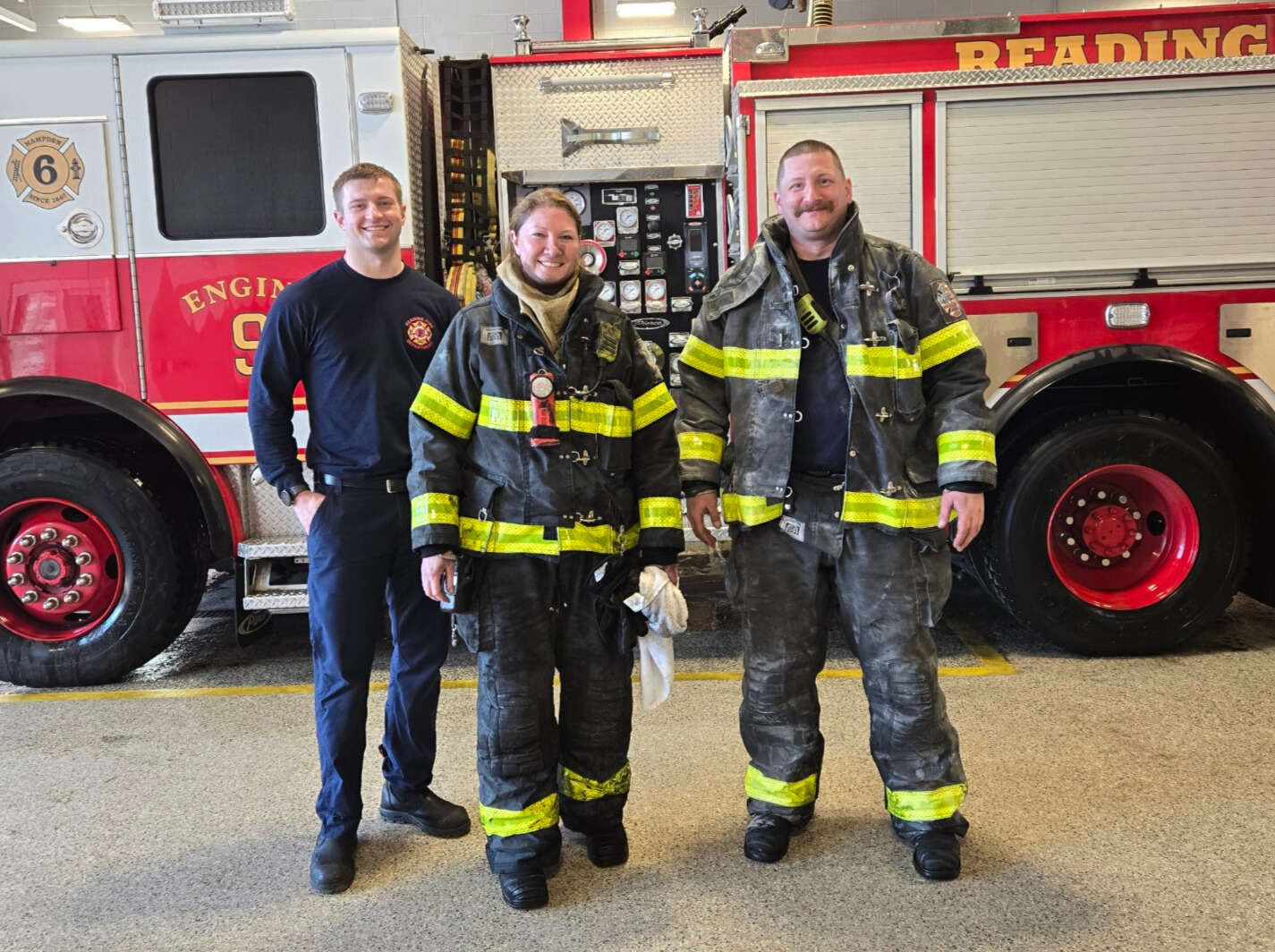
READING — Lt. Rebecca Zentmyer is the only professional female firefighter in Reading.
She’s been the lone woman since she started in 2017 — through her training and during her union’s discussion of the need for a maternity leave policy.
As a former Marine, she connected with other former service members in her fire company and appreciated her commanding officers treating her no differently from other rookies.
She didn’t realize the advice and camaraderie that other women in the profession experience until she attended a seminar for female firefighters a few years ago.
“You don’t know what you don’t have until you see other people that had it,” she said in a recent interview.
The Reading Fire Department employs 95 men and one woman to extinguish fires. That’s the largest gap between men and women city employees, according to a Spotlight PA analysis of 2026 salary data. Gender discrepancies persist across emergency services, though most are not as stark as in the fire department. Women make up 9% of police patrol officers and 22% of non-firefighter paramedics, compared to 34% of general city workers.
Reading’s highest-ranking women in the police and fire departments, and two outside experts, all independently agreed that the city should not specifically recruit women to fix the gap. The goal, they argued, should be to expand the applicant pool to more accurately represent the community — especially as emergency services face declining general recruitment nationwide.
“Some people assume that we’re trying to push men out,” said Tanya Meisenholder, director of police research with the New York University Law School Policing Project. “That’s not what we’re trying to do at all. What we’re trying to say is that you have this whole other pool of people that might be interested in a career in policing when most agencies across the U.S. are experiencing challenges with recruitment and retention.”
Reading has taken some steps in recent years to increase the city’s general applicant pool, including hiring a designated recruiter, a move City Manager Jack Gombach said has helped diversify the overall city workforce.
However, Reading lacks policies that outside researchers agree would most significantly impact retention of women professionals: family leave, internal mentorship programs, and child care options.
Benefits of the policies extend to all employees, not just women, said Meisenholder, a former New York City police officer. She works with the 30×30 project, an initiative that aims to help policing agencies reach 30% women representation in police recruitment classes by 2030. At least 10 Pennsylvania departments are members, including Lancaster and Philadelphia.
If departments don’t reach 30%, they are encouraged to analyze why their agencies are not attracting a wider array of applicants, Meisenholder said.
“The last thing I would want is to encourage a woman to go to a police department where it’s not healthy for her, or where they don’t accept women,” she said. “So, putting aside the 30%, what we asked them to do is engage with their officers and think about what challenges they’re facing.”
What keeps women from emergency services?
Corinne Bendersky, a UCLA professor who studies workplaces, said women represent approximately 4% of professional firefighters nationally — a smaller number than the estimated 8% of women in the Marines, which has the smallest representation of women in any U.S. military branch. The highest percentage of women Bendersky knew of in any one professional fire department in the U.S. was 6%.
Police departments have a higher percentage of female officers, but the largest representation of women is among civilian workers (such as 911 dispatchers, record keepers, and assistants), Meisenholder said. In Reading, these workers are primarily classified under the police department’s special services division.
Meisenholder told Spotlight PA that around 14% of U.S. police officers are women, but local averages depend on the type of agency. Of approximately 18,000 police departments across the country, for example, around 40% have no women in the ranks, largely because they are in rural areas with few employees.
Women offer benefits to their departments, despite being few in number, Meinsenholder said. Female police officers statistically have lower rates of using excessive force, being named in lawsuits, and making fewer discretionary arrests, according to research from 30×30.
Fire departments specifically will “never be 50/50” in gender representation, but women bring different skills and add a “tool to the toolkit,” Bendersky said. As emergency responders, firefighters may be the first to the scene in cases of domestic violence, she said, and survivors may be more comfortable with female medical professionals.
“We as a public are actually suffering for the low representation of women in the fire service,” Bendersky said.
Change has been slow in emergency service departments, Meisenholder told Spotlight PA. Many women fall out of the application process for both police and fire departments during the entry fitness exams, according to both Meisenholder and Bendersky.
The tests, the researchers agreed, are just as important to the culture of the departments as to the actual duties of police and fire officers. However, it is important to consider what aspects of the exams are still relevant to the job and where technology has changed day-to-day requirements, they said. Separating paramedics and firefighters, for example, as Reading has done, helps bring in more types of workers, according to Bendersky.
Deputy Chief Luz Shade, the highest-ranking female officer in the Reading Police Department, agreed, noting an example of a short-lived portion of the fitness exam: the ability of the applicant to jump about six inches higher than their tallest reach.
The department ensures trainees meet the state’s minimum requirements, and enforces a number of its own. Some of those additional requirements greatly serve the officers, such as being able to shoot at night, but others, like the jump, have not served a clear-cut purpose, Shade said.
The department rescinded the jumping test after a higher-ranking agency stopped requiring it, Shade said. The test did not serve a specific purpose, and needlessly came more naturally for certain recruits, she argued.
She and Zentmyer said fitness exams are also a test of mental agility.
“If there’s a test put in front of me … and this is called, ‘You have to survive, and you got to get this done,’ I’m gonna get it done,” Shade said.
New technologies, such as lighter ladders, would be welcome in the fire department. Adjusting the physical standards would not be, Zentmyer said.
“If the physical agility test was lowered to allow more people in, that would be the complaint,” Zentmyer told Spotlight PA. “The initial testing phase of your ability to endure, it’s not just strength. It’s a mental block more than anything.”
How can agencies retain more women?
Shade’s experience in the police department has incrementally changed as she moved up the ranks, she said.
She sees fewer women at the leadership conferences she attends. She heard rumors about herself when she was first promoted, alleging she may have bypassed tests to earn her place — a falsity, as she had to pass the same civil service exams as her male coworkers.
“When you’re a patrol officer, you’re just out there doing your job,” Shade said. “You’re not in anyone’s eyes or ears. As you start moving up the ranks, then you’re noticed, and then everything’s scrutinized. Good or bad, the spotlight is on you.”
Women are less represented in emergency service leadership positions, Meisenholder said, so getting them through the door is not the final goal. Departments also have to consider how to retain them.
Ensuring safety equipment can properly fit women or making considerations for pregnancy and lactation can make a difference, she said. During her time in the NYPD, the department had a women’s mentorship program that allowed officers to learn what was expected in each role and provided support as they moved up the ranks.
The 30×30 project encourages agencies to collect data on where in their careers women tend to “fall out” of the job. She said many do not stay their full 20 years in the field because the schedule is unsustainable when they decide to start a family.
This makes family leave and child care important benefits for officers, Meisenholder said.
Few cities have child care options for employees, but national policing organizations are advocating for added options given the 24-hour nature of the job, Meisenholder said.
Reading does not offer child care for city employees, nor does it have its own paid parental leave policy. Pregnant workers and new parents instead use paid time off or sick leave, or register for the federal Family and Medical Leave Act.
Gombach, the city manager, said Reading wants to find ways to better support the family lives of emergency workers, especially as they look to recruit. The city has considered offering employees some form of child care, but is financially hindered in a way the private sector is not, he said.
However, he said the administration wants to start talking with the city’s unions over the next year about potential family leave policies.
The city’s union contracts have provisions that advise light duty for pregnant employees with a doctor’s note, or alternatively, temporary sick leave for employees supporting their pregnant spouses. Eligible employees can take up to 12 weeks of unpaid leave through FMLA. They are required to use accrued vacation or sick time at the same time as their FMLA leave, according to the city’s employee handbook.
FMLA protects a person’s right to return to their job and has been a huge benefit to Reading employees, but more could be done to support officers, Shade and Zentmyer said. Zentmyer suggested the city could work to keep up with research from the International Association of Firefighters that studies which schedules offer the healthiest work-life balance for employees.
What ultimately matters is each employee’s ability to get the job done, they agreed. Gender does not matter if she can accomplish the task, Zentmyer said, but she recognized that seeing more women in the fields would likely encourage others to try.
“If you have heart for these professions, it’s doable,” Shade said. “It may be somewhat more difficult, but it’s definitely doable.”
BEFORE YOU GO… If you learned something from this article, pay it forward and contribute to Spotlight PA at spotlightpa.org/donate. Spotlight PA is funded by foundations and readers like you who are committed to accountability journalism that gets results.
