



Hawk Mountain Sanctuary announced plans Thursday to replace its aging visitor center with a new, larger facility designed to improve accessibility, expand educational opportunities, and showcase the organization’s conservation work around the world.
The announcement was made during an October 15 press conference at the sanctuary in Albany Township, Berks County, where President Sean Grace joined State Rep. Jamie Barton and Board of Directors Chair Beth Hucker to discuss the project.
The new visitor center is part of a $13 million capital campaign, with demolition of the existing building expected to begin in April 2027. Construction is anticipated to take approximately 14 months, with the new facility expected to open in fall 2028.
“This is a once-in-a-generation opportunity,” Grace said. “We plan to build it, we plan to build it the wrong excuse me, the right way.”
Grace explained that the project has been in development for several years, with the organization spending the past five years refining designs and privately raising funds. He said discussions about replacing the visitor center date back approximately two decades.
The decision to construct an entirely new building rather than renovate the existing facility was driven by structural concerns and the cost of addressing those problems.
“Our current visitor center has serious structural integrity issues,” Grace said, also noting that portions of the building, including the Wings of Wonder Gallery, are not accessible to visitors with disabilities.
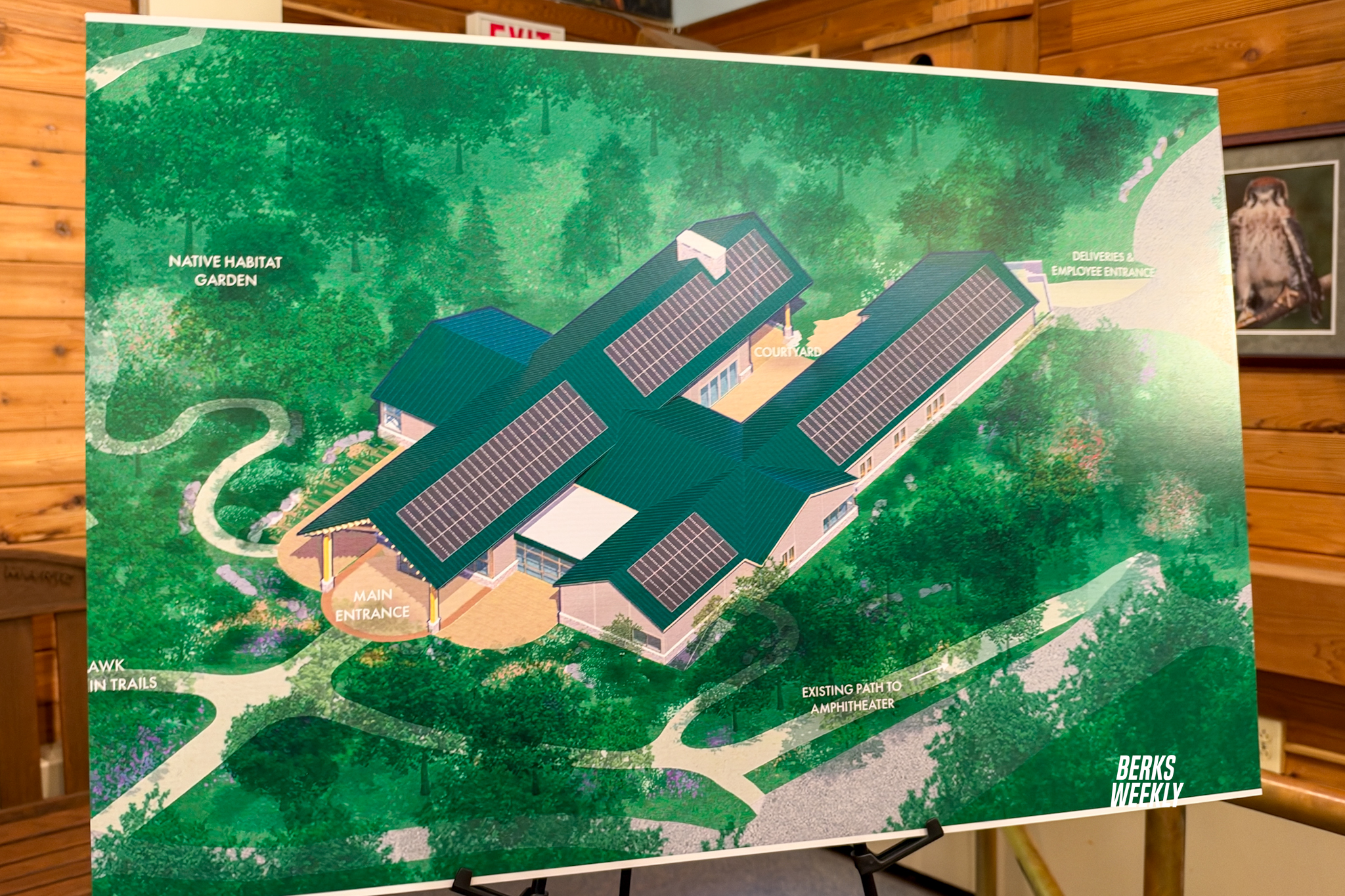
The replacement facility will be approximately 31% larger than the existing visitor center and feature a single-floor layout to improve accessibility. Plans include a vaulted ceiling nearly 30 feet high, new exhibits, additional office space, and a multipurpose educational room.
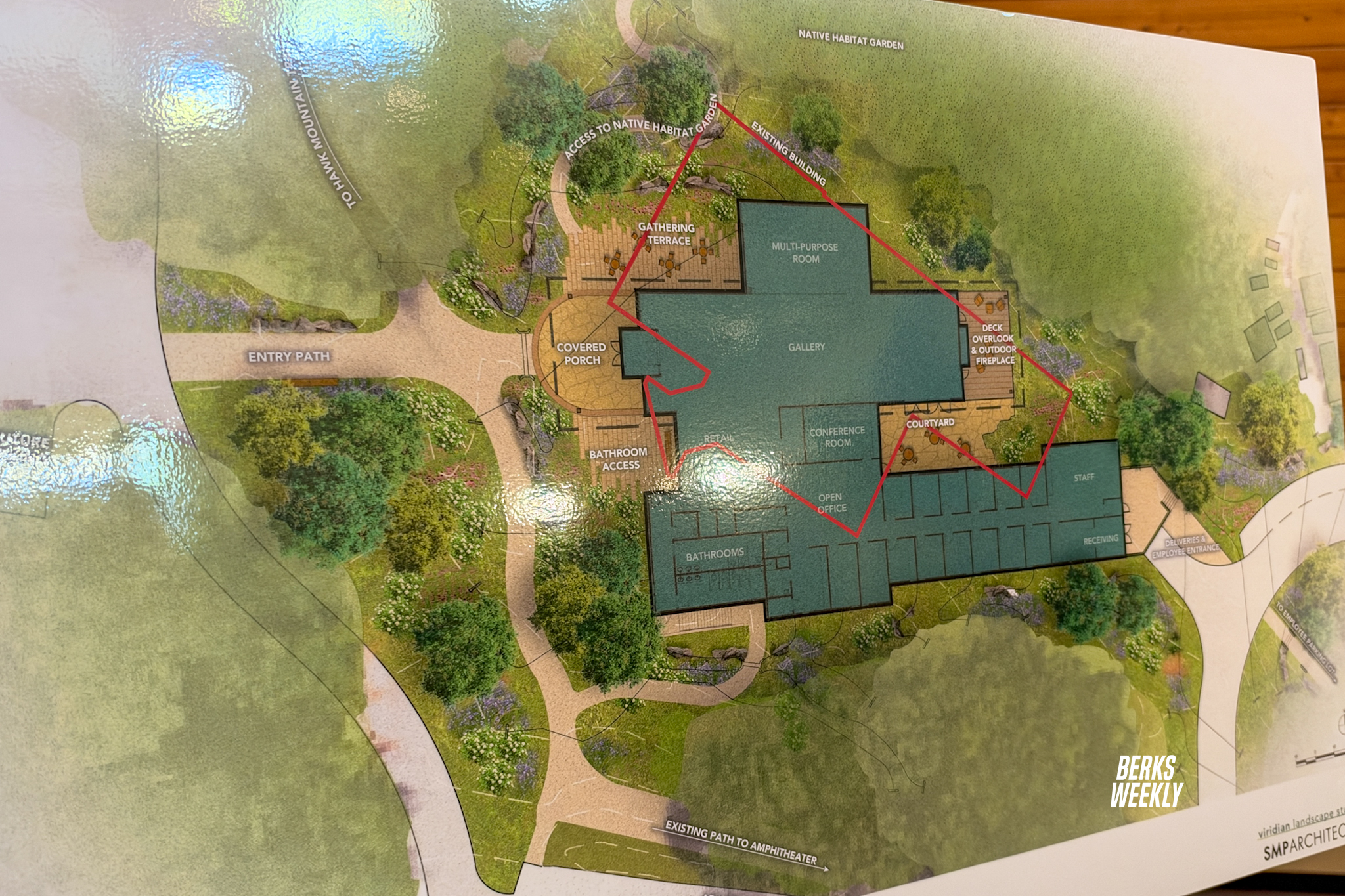
Covered outdoor gathering areas will be incorporated into the front and rear of the building, including a courtyard and rear deck overlooking the sanctuary’s Native Habitat Garden.
The design also calls for improved connections to the sanctuary’s existing accessible trail and outdoor spaces. Grace said the building will be oriented along an east-west axis to provide southern roof exposure for potential solar energy use.
The sanctuary also intends to preserve and reuse selected features from the current building, including stained glass windows created by local artisans and a prominent wooden beam bearing the Hawk Mountain name.
Grace emphasized that the new center will be designed primarily around the visitor experience while highlighting the scientific research, conservation initiatives, and educational programs that extend well beyond the mountain itself.
“First and foremost, we really took a look at this from what do our visitors need? What do they want? What do we need as far as to put across education?” Grace said.
Although the current visitor center will be demolished, Hawk Mountain Sanctuary will remain open throughout construction.
Temporary workstations and facilities will be established near the parking lot and pavilion, while some employees will work from trailers and other existing buildings on the property.
Educational programs, hiking opportunities, conservation research, and seasonal raptor counts are expected to continue, although some activities may be adjusted to accommodate construction.
“We will be open for programming the entire time,” Grace said. “We have restrooms on site. We’ll have some limited facilities here on site. We have our amphitheater, which we built four years ago, so we expect to be completely in business.”
The organization is also continuing its fundraising efforts to reach the $13 million campaign goal. While Grace said the sanctuary has received substantial support from donors, additional contributions are still needed.
Hucker reaffirmed the board’s commitment to the project and praised the staff and volunteers responsible for advancing the sanctuary’s scientific and educational mission.
“The board’s commitment to a new visitor center will advance the scientific and educational aspects of our organization exponentially,” Hucker said. “As Sean mentioned, we have a $13 million goal. We are working hard to cross that finish line.”
She added that the organization is working toward obtaining the necessary permits before construction begins.
Barton, who grew up in the area, spoke about Hawk Mountain’s importance to the surrounding community and its international reputation for conservation and education.
“What we think of is education, conservation, and certainly recreation,” Barton said. “People come here for different things, but they get all three of those.”
He also highlighted the sanctuary’s economic contributions to the region, noting that visitors traveling to Hawk Mountain support nearby businesses, restaurants, artists, and accommodations.
Grace said the sanctuary currently attracts approximately 70,000 visitors annually and expects that number to increase following the completion of the new facility.
He explained that visitation has become more evenly distributed throughout the year as hiking and outdoor recreation have grown in popularity, rather than being concentrated primarily during the fall raptor migration.
“We really want to try to make this a destination location,” Grace said.
Beyond tourism, the new visitor center will provide an opportunity to better communicate Hawk Mountain’s international conservation efforts.
Since its founding in 1934, the sanctuary has become a center for raptor migration research and conservation. According to Grace, its training programs have supported 542 individuals from 78 countries, many of whom have continued into scientific research and conservation leadership positions.
The organization also participates in research involving American kestrels, vultures, snowy owls, and other raptor species, along with statewide bird monitoring initiatives.
Grace said the new exhibits will help visitors better understand that work and the sanctuary’s role in protecting birds of prey around the world.
The project will also place greater emphasis on the Native Habitat Garden, which Grace described as an important educational resource. Plans call for better integration between the garden and visitor center, along with improvements to bird-feeding areas and opportunities for visitors to learn about native plants.
Grace said the organization hopes the completed facility will become a model for nature centers internationally.
“If there’s an award in 2028 for the best new visitor center on the globe, I want it to be this one right here,” Grace said.
The sanctuary expects to begin demolition in spring 2027, with construction and fundraising efforts continuing as it prepares for the planned fall 2028 opening.
