



With less than a week remaining before Pennsylvania’s deadline for removing skill game machines from businesses, state Rep. Manuel Guzman joined business owners, volunteer fire department representatives and industry supporters Thursday evening in Reading to discuss the potential financial impact and uncertainty surrounding the machines’ future.
The informational session, held October 8 at Reverb Club on North Ninth Street, brought together individuals concerned about the loss of revenue from skill games, which are commonly found in convenience stores, restaurants, taverns, private clubs and other establishments throughout Pennsylvania.
The meeting was organized in coordination with Pace-O-Matic, the software developer behind Pennsylvania Skill games, as the industry prepared for an October 13 compliance deadline following a Pennsylvania Supreme Court ruling.
During the session, Guzman, D-Berks, expressed frustration that state lawmakers had not reached an agreement to regulate and tax the machines before the deadline.
“I felt that pit in my stomach because I knew that in just a few hours from there, now I was going to have to stand in front of all of you and tell you that the job that I’m a part of failed me,” Guzman said.
He acknowledged responsibility on both sides of the political aisle, saying disagreements over taxation and how potential revenue would be distributed had contributed to the legislative impasse.
According to Guzman, lawmakers have struggled to agree on whether revenue generated by regulating skill games should support the state’s general fund or public transportation, among other considerations.
He also discussed concerns about the potential tax rate that could be imposed on the machines if legislation is eventually approved.
Supreme Court ruling and enforcement deadline
The uncertainty follows a June 15, 2026, Pennsylvania Supreme Court decision determining that the skill game devices at issue qualify as slot machines under the state’s Gaming Act and are subject to existing gambling laws.
The court temporarily delayed implementation of its decision for 120 days, recognizing the impact an immediate enforcement action could have on businesses and others that had relied on previous court rulings.
That period expires October 13.
According to the Pennsylvania State Police, beginning October 14, businesses possessing or operating unauthorized skill game machines outside licensed gaming facilities could face enforcement action, including seizure of machines, associated equipment and proceeds, as well as potential criminal charges.
State Police have advised businesses to arrange for the removal of the machines and associated equipment before the deadline. The agency has also clarified that simply unplugging, powering off or temporarily disabling a machine does not necessarily satisfy the law.
Local organizations describe financial concerns
Scott Reitnauer, of the Eastern Berks Fire Department, spoke about the financial challenges facing volunteer emergency services and the role revenue from skill games plays in supporting operations.
Reitnauer said the department’s social quarters had taken out a $150,000 loan earlier this year to repair the firehouse roof and a wall. He expressed concern about how the organization would continue making payments without the additional revenue.
“This helps everything for payroll, keeps our lights on, keeps fire trucks equipped,” Reitnauer said.
He also discussed the limitations of traditional fundraising efforts, explaining that although prices for fundraising dinners have increased over the years, the profit generated has remained largely the same.
“Without the skills, we’re going to be in a lot of trouble,” he said.
Joe Magee, owner of Marty Magee’s Irish Pub in Prospect Park, Delaware County, described how skill games had become an important part of his business’s finances over the past decade.
Magee said the revenue initially provided additional money for improvements, but following the COVID-19 pandemic and increasing operating expenses, it had become a regular part of the establishment’s budget.
He warned that losing the revenue could force businesses like his to increase prices at a time when customers are already dealing with higher costs.
“If these skill games go away, the only thing we can possibly do is raise our prices to meet today’s inflation,” Magee said.
Other attendees expressed similar concerns about maintaining their operations and continuing charitable contributions.
A representative of the Lucky Star Athletic Association in Reading said the organization regularly supports local charities and youth programs but may have to reconsider future donations because of the anticipated financial impact.
Questions raised about enforcement
During a question-and-answer portion of the meeting, several attendees questioned how authorities would enforce the upcoming deadline and whether machines could remain inside establishments if they were permanently disabled.
Scott Naugle, president of Shillington Social Quarters and a retired Reading police officer, raised concerns about differing information businesses had received regarding enforcement.
Naugle said he had contacted law enforcement agencies seeking clarification and was concerned about the possibility of inconsistent enforcement among municipalities.
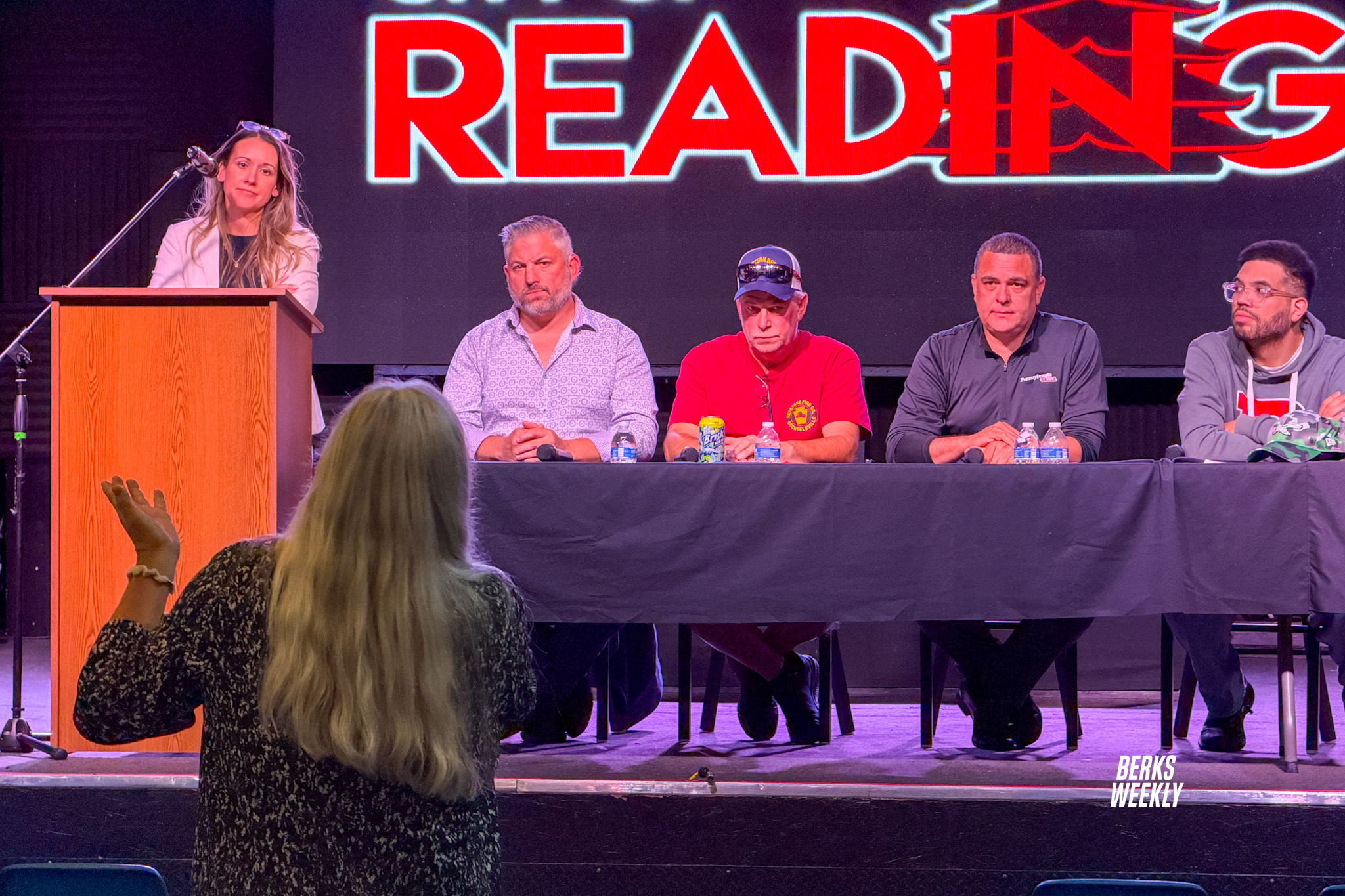
Guzman responded by referencing communications from Berks County District Attorney John Adams and warnings regarding businesses that maintain liquor licenses.
He encouraged business owners to take precautions and work with their vendors to arrange for the removal of the machines.
Representatives from Pace-O-Matic also discussed plans for disabling and removing equipment
Jeanna Bouzek, the company’s Sr. Vice President of Market Operations, said Pace-O-Matic had developed a shutdown plan and was working with operators to prepare for the deadline. She also raised concerns about how quickly distributors could physically remove large numbers of machines.
While industry representatives questioned whether permanently disabled machines should be subject to enforcement, Pennsylvania State Police guidance advises removal and warns that temporarily disabled machines capable of being made operational again remain subject to the law.
Industry supporters call for continued action
Juan Rivera addressed attendees in both English and Spanish, encouraging business owners and community members to contact state lawmakers and advocate for legislation allowing the machines to continue operating under a regulated system.
Rivera emphasized the importance of cooperation among manufacturers, distributors, business owners and elected officials rather than assigning blame for the approaching deadline.
Rachel Albritton, SR. Vice President, Communications for Pace-O-Matic, also encouraged attendees to share personal experiences with legislators, particularly if losing skill game revenue would lead to layoffs, business closures or reductions in community donations.
Guzman told attendees that he believed direct communication with elected officials, particularly visiting legislative offices in person, could be more effective than relying solely on emails and social media messages.
The possibility of obtaining additional time through the courts was also discussed. Guzman expressed doubt that the Supreme Court would extend its original 120-day period.
Although the deadline was approaching without a legislative agreement, Guzman maintained his support for the industry and indicated that efforts to establish a regulatory framework would continue.
“We got a big fight ahead of us,” Guzman said.
